It usually starts as a subtle ache by the time Friday afternoon rolls around. Eventually, that mild discomfort turns into a sharp pain that interrupts your typing, leaving you staring at your hands and asking: why do my wrists hurt? For millions of desk workers, wrist pain is the first physical indicator that their workstation ergonomics are failing them.
However, not all wrist pain is created equal. The internet is quick to label any hand discomfort as “Carpal Tunnel,” but this is often anatomically incorrect. Treating a muscle strain the same way you treat a compressed nerve can delay your recovery and worsen the underlying issue.
This guide provides an informational overview of the differential diagnosis between these conditions. We will break down the mechanics of nerve compression versus general overuse, helping you better understand the signals your body is sending.

The Root of the Problem: RSI vs. Nerve Compression
Why do my wrists hurt? Your wrists hurt primarily due to either repetitive soft tissue damage or localized nerve compression caused by poor desk ergonomics. While general Repetitive Strain Injury (RSI) involves inflamed tendons and muscles, Carpal Tunnel Syndrome specifically involves the pinching of the median nerve.
Understanding this distinction is crucial. An RSI is a broad, umbrella term for damage caused by doing the same motion repeatedly. Carpal Tunnel Syndrome (CTS) is a highly specific medical condition with a distinct set of diagnostic criteria.
Understanding Carpal Tunnel Symptoms
To understand CTS, you must look at the anatomy of your wrist. The “carpal tunnel” is an actual physical passageway at the base of your hand, bounded by bones and ligaments. It is quite narrow, and several tendons run through it alongside a major nerve.
This major nerve is the median nerve. It controls the sensation and movement in your thumb, index finger, middle finger, and half of your ring finger. When the tendons inside this tunnel become inflamed from overuse, they swell. Because the tunnel cannot expand, the swelling crushes the median nerve against the surrounding bone.
This nerve compression creates highly specific carpal tunnel symptoms that differ greatly from a standard muscle ache:
- Tingling and Numbness: You will likely feel a “pins and needles” sensation specifically in the thumb, index, and middle fingers. The pinky finger is usually unaffected because it is served by a different nerve.
- Night Pain: CTS symptoms are notoriously worse at night, often waking sufferers from sleep because fluid accumulates in the arms while lying down.
- Weakness: You may experience a sudden loss of grip strength, causing you to drop lightweight objects like coffee mugs or pens.
General Wrist RSI (Tendonitis and Strain)
If your pain does not match the specific neurological symptoms above, you are likely dealing with a general Repetitive Strain Injury, such as tendonitis.
Unlike nerve compression, tendonitis is the inflammation of the thick cords that attach your muscles to your bones. This is usually caused by holding your wrists at unnatural angles (like bending them sharply upward to type) for thousands of hours.
The symptoms of a general RSI typically include:
- A dull, localized ache or burning sensation directly over the affected tendon.
- Pain that worsens immediately with movement and subsides with rest.
- Stiffness in the joint, especially first thing in the morning.
- Crucially, there is usually no tingling or numbness associated with a standard tendon strain.
For a deeper dive into the mechanics of these general overuse injuries and how to heal the soft tissue, refer to our foundational guide on Repetitive Strain Injury (RSI): Symptoms, Prevention & Recovery.
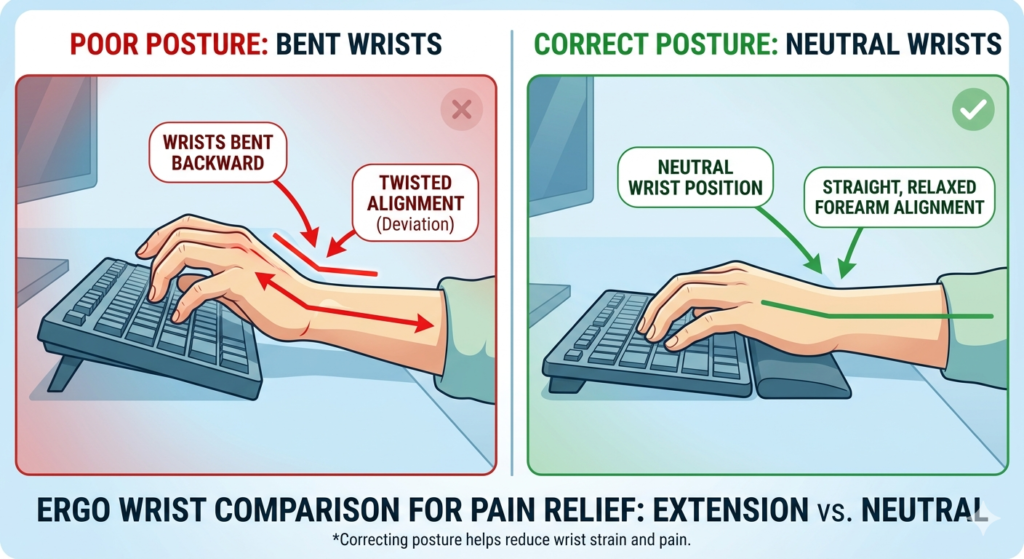
Ergonomic Tweaks to Reduce Pressure
Whether you suspect nerve compression or a general strain, the immediate physical remedy is the same: stop aggravating the tissue. You must correct the physical geometry of your workspace to keep your wrists entirely neutral.
When using a standard flat mouse, your forearm bones cross over each other (pronation), which naturally twists the wrist and puts pressure directly on the carpal tunnel. Changing your hand position can provide immediate mechanical relief. Utilizing a device that allows your hand to rest in a natural “handshake” posture uncrosses the forearm bones and lifts the sensitive underside of the wrist completely off the desk.
Furthermore, ensure your keyboard is positioned at or slightly below your elbow height. This prevents you from having to bend your hands backward (extension) to reach the keys, which is a primary trigger for tendonitis.
Conclusion
The next time you find yourself wondering, “why do my wrists hurt?”, pay close attention to the specific type of discomfort you are feeling. An aching, burning joint usually points to a general RSI or tendonitis caused by muscular fatigue. Conversely, numbness, weakness, and shooting pains in specific fingers point toward nerve compression. By understanding the mechanical differences between these conditions, you can make smarter ergonomic adjustments and have a much more productive conversation with your doctor regarding your recovery.
Disclaimer: This article is for informational purposes only and does not constitute medical advice. Always consult a healthcare professional for a proper diagnosis.
Frequently Asked Questions (FAQ)
Can typing on a flat keyboard cause carpal tunnel?
Typing itself does not directly cause carpal tunnel syndrome, but typing with poor posture (wrists resting heavily on the desk edge or bent sharply backward) can compress the median nerve and trigger or worsen the condition over time.
How can I test myself for Carpal Tunnel Syndrome?
While only a doctor can diagnose CTS (often using an EMG test), a common preliminary screening is Phalen’s maneuver. Press the backs of your hands together with your fingers pointing down (like an upside-down prayer) and hold for 60 seconds. If this reproduces your tingling and numbness, CTS is highly suspected.
Do wrist rests actually help prevent wrist pain?
Wrist rests can be beneficial if used correctly, but they are often misused. You should rest the heel of your palm (the meaty part) on the pad during pauses in typing. Never rest the actual wrist joint on the pad while actively typing, as this applies direct pressure to the carpal tunnel.
Why does my pinky finger tingle if it isn’t Carpal Tunnel?
If your pinky and ring fingers are tingling, it is usually a sign of Cubital Tunnel Syndrome. This condition involves the compression of the ulnar nerve, which generally happens at the elbow joint rather than the wrist.