It is the undisputed number one complaint of the modern office worker: a dull, persistent ache in the lower spine that begins around mid-day and intensifies until you finally stand up. If you are constantly shifting in your chair, massaging your lower back, or relying on pain relievers just to get through the workweek, your workspace geometry is likely working against your anatomy.
Human bodies are to move, walk, and stand. The act of sitting in a fixed position for eight hours is a mechanical challenge for our physiology. When we sit incorrectly, we disable the muscles designed to hold us upright and transfer the entire weight of our upper body directly onto the passive structures of the lower spine.
This troubleshooting guide explains the physical mechanics behind this discomfort. We will explore the specific causes of lower back tension and provide actionable, immediate solutions to relieve the pressure and restore your comfort.
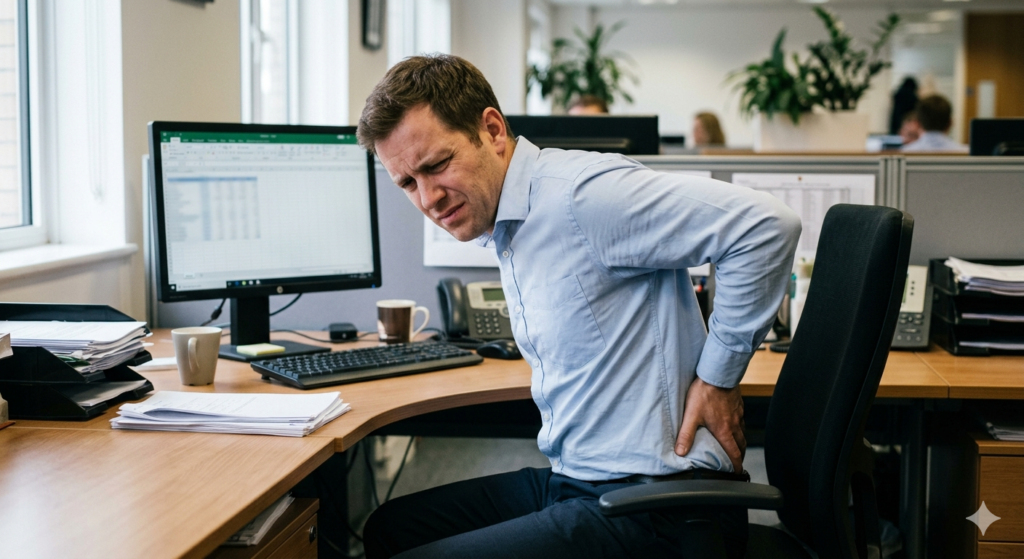
The Mechanics of Seated Back Pain
Why do we experience lower back pain sitting? Sitting places significantly more mechanical load on the lower spine than standing. When seated, the pelvis naturally rolls backward, flattening the natural inward curve of the lumbar spine, which stretches ligaments, causes muscle fatigue, and drastically increases intervertebral disc pressure.
Unlike dynamic movements that allow muscles to contract and release, sitting requires continuous, static muscle exertion. Much like the cumulative damage discussed in our foundational guide on Repetitive Strain Injury (RSI): Symptoms, Prevention & Recovery, this static loading eventually starves the soft tissues of oxygen and blood flow, leading to deep, aching discomfort.
Cause 1: Lumbar Strain and Ligament Stretching
Your lower back, known as the lumbar spine, has a natural inward curve (lordosis). This curve acts as a shock absorber, distributing the weight of your torso, head, and arms evenly across your vertebral discs.
When you sit in a standard office chair, especially one without adequate support, your pelvis tends to tilt backward (posterior tilt). This action physically straightens the lower spine, turning the natural “S” shape into a “C” shape.
Holding this “C” shape forces the muscles and ligaments in your lower back to stretch beyond their resting length. Over the course of a workday, this continuous stretching causes lumbar strain. The muscles become exhausted from trying to pull the spine back into its natural alignment, resulting in a sensation of tightness and burning pain.
Cause 2: Increased Spinal Disc Pressure
Perhaps the most damaging aspect of prolonged sitting is the physical compression it creates. Biomechanical studies consistently show that sitting increases disc pressure in the lower back by up to 40% compared to standing. If you lean forward to look at your monitor while seated, that pressure can spike by over 90%.
The intervertebral discs are the gel-like cushions between your spinal bones. When sitting continuously squeezes the front of these discs, the gel inside is pushed backward toward the spinal canal. Over time, this intense pressure can cause the disc to bulge or herniate.
When a disc bulges outward, it can press against the sensitive nerve roots exiting the spine. This is a common trigger for sciatica, a sharp, radiating pain that shoots from the lower back down through the buttocks and into the back of the leg.
Actionable Solutions for Immediate Relief
If you are currently experiencing lower back pain, you must immediately alter the biomechanics of your seated posture to offload the pressure from your lumbar spine.
1. Re-establish Pelvic Support
The key to fixing the lumbar curve is controlling the pelvis. You must sit all the way back in your chair so your buttocks touch the base of the backrest. This allows the chair’s built-in lumbar support to push gently against your lower back, preventing the pelvis from rolling backward.
If your chair is completely flat or too deep for your legs, you cannot achieve this support naturally. Adding a supplementary layer to elevate your hips slightly above your knees can instantly encourage a forward pelvic tilt, restoring your natural lumbar curve and relieving the strain on your lower back muscles.
2. Open the Hip Angle
Sitting at a strict 90-degree angle for eight hours can be exhausting for the lower back. You can immediately reduce disc pressure by opening your hip angle to roughly 100 or 110 degrees. Unlock the tilt mechanism on your chair and recline slightly. As long as your spine remains supported and you do not slouch, reclining shifts a significant portion of your upper body weight off your lower spine and onto the backrest.
3. Plant Your Feet Firmly
Your feet act as the anchor for your entire posture. If your feet dangle or rest lightly on the casters of your chair, your lower back must work overtime to stabilize your torso. Place your feet completely flat on the floor or on a solid footrest to create a stable, closed-chain mechanical loop that supports your spine from the ground up.
Conclusion
Experiencing lower back pain sitting at your desk is a mechanical problem that requires a mechanical solution. By understanding how poor seated posture leads to lumbar strain and drastically increases disc pressure, you can take immediate steps to protect your spine. Prioritizing pelvic support, utilizing the backrest of your chair, and keeping your feet firmly planted will help restore your natural spinal curves, significantly reducing pain and preventing long-term structural damage.
Frequently Asked Questions (FAQ)
Why does my lower back hurt only when I sit at my desk?
If your pain occurs only at your desk, it is highly likely a postural issue. Your chair may lack proper lumbar support, or your desk setup may be forcing you to lean forward, which rapidly increases pressure on the spinal discs and strains the back muscles.
Is it better to sit or stand for lower back pain?
Standing generally places less pressure on the lumbar discs than sitting. However, standing perfectly still for long periods can also cause fatigue. The best approach is to alternate between sitting in a supported, neutral posture and standing or walking every 30 to 60 minutes.
Can a bad chair cause sciatica?
A bad chair itself does not directly cause sciatica, but sitting in a chair that promotes slouching dramatically increases disc pressure. Over time, this pressure can cause a lumbar disc to bulge and compress the sciatic nerve, triggering the radiating pain associated with sciatica.
How do I decompress my lower back after sitting all day?
A simple way to decompress the lower back is to lie flat on your back on the floor with your knees bent and feet flat, or with your calves resting on a chair (the 90-90 supine position). This neutralizes the pelvis and allows the lower back muscles to completely relax and the discs to rehydrate.