Sitting for eight hours a day essentially locks the human body into a rigid, folded position. This prolonged immobility starves your soft tissues of oxygen and leads to the deep, aching stiffness that many desk professionals experience by mid-afternoon. When your muscles are held in a shortened state for hours, they physically adapt, causing long-term postural imbalances.
You do not need a grueling gym session to reverse this daily damage. You simply need targeted, consistent movement to break the static tension.
This guide provides an actionable, 5-minute exercise sequence that requires no change of clothes and minimal space. We will cover specific movements designed to undo the forward slouch, open the hips, and restore vital circulation to your entire body.
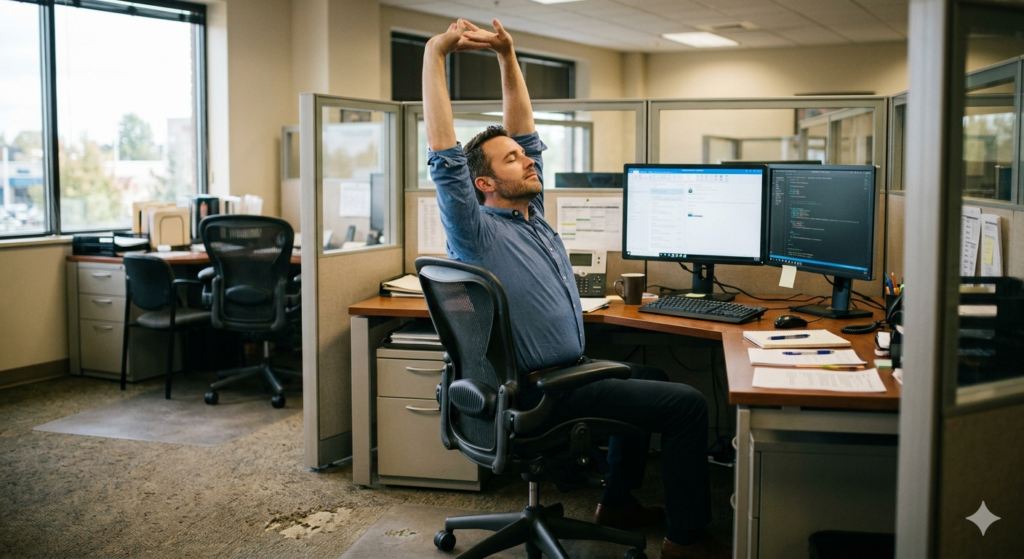
The Purpose of Daily Movement
What is a desk stretches routine? A desk stretches routine is a short, targeted sequence of physical movements designed to counteract the restrictive posture of sitting. It focuses on opening the chest, mobilizing the spine, and extending the hips to restore flexibility and provide immediate stiffness relief.
When you sit still, your heart rate drops and circulation to your extremities slows down. Engaging in a brief stretching session acts as a manual pump for your vascular system. It pushes stagnant fluid out of the tissues and rushes fresh, oxygenated blood flow into tired muscles, which instantly improves both physical comfort and cognitive alertness.
Upper Body: Reversing the Slouch
The most visible consequence of desk work is the forward roll of the shoulders. Your upper body stretches must focus on pulling your framework backward.
1. The Seated Chest Opener (1 Minute)
Sitting at a keyboard continuously tightens your pectoral muscles.
- Sit on the edge of your chair with your feet flat.
- Reach both hands behind your back and interlace your fingers.
- Straighten your arms and gently lift your hands upward while pushing your chest out.
- Hold for 30 seconds, release, and repeat. You should feel a deep stretch across your collarbones and the front of your shoulders.
2. The Upper Trapezius Neck Stretch (1 Minute)
To relieve the tension that causes afternoon headaches, target the sides of your neck.
- Sit up straight and grasp the bottom edge of your chair with your right hand to anchor your shoulder.
- Gently tilt your left ear toward your left shoulder until you feel a pull along the right side of your neck.
- Hold for 30 seconds, then switch sides. Do not pull with your hands; let gravity do the work.
Lower Body: Unlocking the Hips and Legs
While the upper body handles the visual slouch, the lower body suffers from severe joint restriction. Your hip flexors are kept in a constantly shortened state while seated, which pulls directly on your lower back.
3. The Seated Figure-Four (1.5 Minutes)
This stretch specifically targets the glutes and the piriformis muscle, providing excellent stiffness relief for the lower back and sciatic nerve.
- Sit with both feet flat on the floor.
- Lift your right leg and place your right ankle across your left knee, creating a “4” shape.
- Keep your back perfectly straight and gently hinge forward at the hips.
- Hold for 45 seconds, then switch to the left leg.
4. The Standing Hip Flexor Extension (1.5 Minutes)
You must physically stand up to unbend your hips.
- Stand up and take a step backward with your right foot, as if entering a shallow lunge.
- Keep your back straight and tuck your pelvis slightly forward.
- Bend your left knee slightly until you feel a stretch down the front of your right thigh and hip.
- Hold for 45 seconds per leg to restore flexibility to the front of your body.
Integrating these movements into your daily schedule is a core component of the lifestyle habits discussed in our pillar guide, Workspace Wellness: Building a Routine for Longevity.
If you work from home and have the floor space, transitioning out of the chair entirely is highly beneficial. Keeping a soft, supportive surface like a Foam Roller directly next to your desk removes the friction of getting down on the floor. Taking just five minutes to perform a Child’s Pose or Cat-Cow stretch on the floor completely unloads the spine and offers a level of decompression that a chair simply cannot provide.
Conclusion
Counteracting the physical toll of office work does not require hours of complex exercise. A dedicated, 5-minute desk stretches routine is often enough to break the cycle of static tension and protect your musculoskeletal health. By systematically targeting your chest, neck, hips, and glutes, you manually restore vital circulation and preserve your joint mobility. Prioritize this daily habit to ensure you log off each evening feeling physically refreshed rather than stiff and fatigued.
Frequently Asked Questions (FAQ)
How often should I do desk stretches?
For the best results, you should perform a brief 2 to 3-minute stretching routine every one to two hours. This frequency prevents the muscles from adapting to the shortened, seated position and maintains steady blood flow throughout the workday.
Can a desk stretches routine replace a workout?
No. Desk stretches are specifically meant for mobility, stiffness relief, and postural correction. They do not provide the cardiovascular benefits or muscular hypertrophy (strength building) that a dedicated workout routine offers.
Will stretching fix my posture permanently?
Stretching is only half of the solution. It lengthens tight muscles (like the chest and hip flexors), but you must also strengthen the opposing weak muscles (like the upper back and glutes) to hold your body in a permanently improved posture.
Is it normal to feel pain while stretching at my desk?
No, stretching should never be painful. You should feel a mild to moderate pulling sensation (tension), but sharp, stabbing, or burning pain means you are pushing the joint too far. Always stretch gently and breathe deeply.