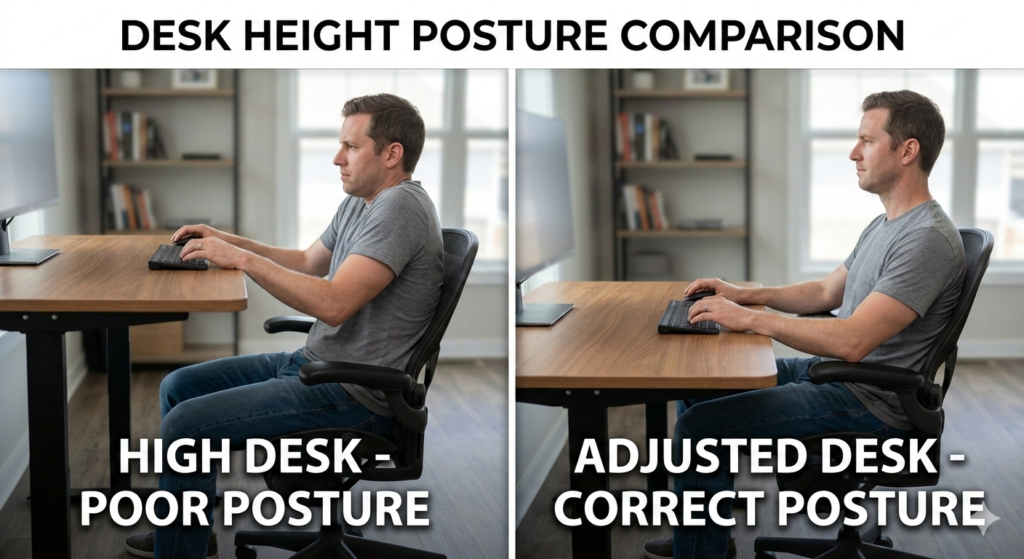
If you experience chronic tension in your trapezius muscles (the area between your neck and shoulders) after a long day of work, your desk is likely too high. It is a widespread issue in modern offices: most “standard” desks are built to be 29 or 30 inches tall. However, ergonomic data suggests this height is only appropriate for a person who is roughly 6’2″ or taller.
For the vast majority of the population, a standard desk forces the arms to reach upward, causing the shoulders to shrug perpetually. Over weeks and months, this subtle elevation creates knots, tension headaches, and fatigue.
This guide will walk you through the precise method for measuring desk height suited to your specific anatomy, ensuring your workstation fits you like a tailored suit.
The Elbow Rule: Your Ergonomic Anchor
The most important metric in desk ergonomics is not your total height, but your “seated stature” and specifically, your elbow height.
Measuring desk height correctly begins with the “Elbow Rule.” This rule states that when seated comfortably with feet flat on the floor, the keyboard and mouse should be positioned exactly at the height of your relaxed elbows, creating a 90 to 100-degree angle at the joint.
If your keyboard is higher than your elbows, your wrists must flex backward (extension), and your shoulders must lift to compensate. This is the mechanical root of most upper body office pain.
Step-by-Step Measurement Guide
To determine your exact number, you will need a measuring tape and your current office chair.
1. Anchor Your Feet
Start by adjusting your chair. Ignore the desk for a moment. Sit back in your chair so your lower back touches the lumbar support. Adjust the seat height until your feet are firmly planted flat on the floor and your knees are bent at roughly 90 degrees. This provides the stable base required for accurate measurement.
2. Find Your Resting Elbow Height
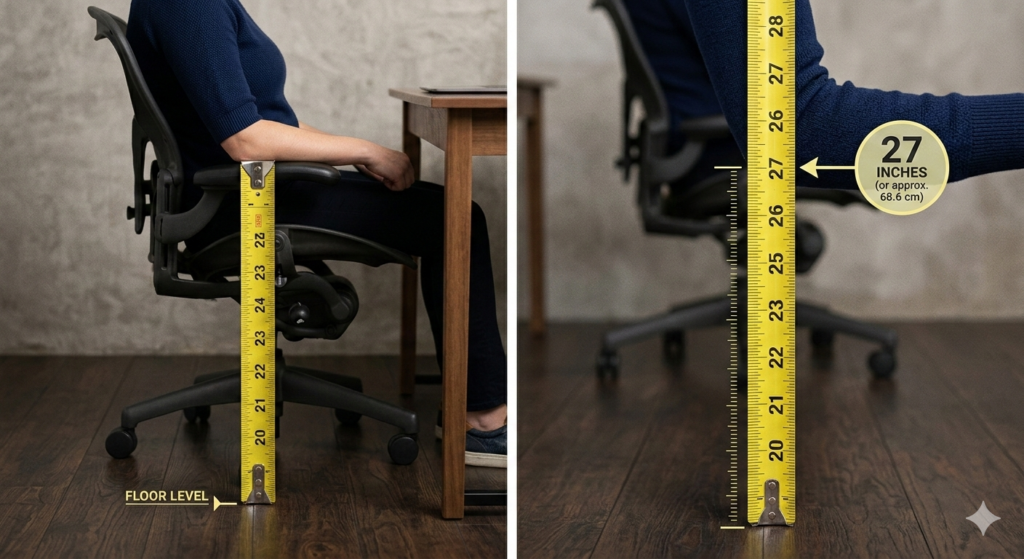
Relax your shoulders completely. Let them drop away from your ears. Bend your elbows to a 90-degree angle, as if you are typing on an imaginary keyboard in your lap.
Measure the vertical distance from the floor to the underside of your elbow (the olecranon process). This number is your baseline table height. For a person who is 5’9″, this is often around 26 to 27 inches—significantly lower than the standard 30-inch desk.
3. Account for “Typing Level”
Your physical desk surface needs to be slightly lower than your elbow measurement to account for the height of the input devices. If your keyboard is 1 inch thick, your desk surface should be 1 inch lower than your elbow height to keep your wrists neutral.
Addressing the “Desk Clearance” Problem
Once you have your ideal number, you may face a logistical problem: your desk is too tall, and the legs are not adjustable.
You have two primary solutions:
- Raise Yourself: You can raise your chair until your elbows are level with the desk. However, this will pull your feet off the floor, requiring a footrest to maintain hip stability.
- Lower the Surface: If you cannot cut the legs off your desk, the most ergonomic solution is to bring the peripherals down to you.
Installing an under-desk tray effectively lowers your typing surface by 3 to 5 inches, placing the keyboard directly in your lap where your elbows naturally fall. This allows you to keep your feet on the ground and your shoulders relaxed without buying a new desk.
The Role of Desk Clearance
While lowering the input devices is crucial, you must also ensure you have adequate desk clearance—the space between the tops of your thighs and the underside of the desk.
According to the principles outlined in our “The Ultimate Ergonomic Desk Setup Guide: Measurements & Rules“, you need enough room to cross your legs or shift position slightly without banging your knees. If you add a tray or drawer, ensure it does not encroach on this legroom, as restricted movement can lead to circulation issues.
Conclusion
Determining the correct desk height is a math problem, not a guessing game. By prioritizing your elbow height and seated stature over the aesthetic of a standard desk, you protect your neck and shoulders from unnecessary strain. Whether you choose to modify your desk or modify your chair height, the goal remains the same: a neutral, relaxed posture that allows you to work pain-free.
Frequently Asked Questions (FAQ)
What is the standard height of an office desk?
The industry standard for office desks is typically 29 to 30 inches. This is often too high for anyone under 6 feet tall to use ergonomically without adjustments.
How do I fix a desk that is too high?
You can fix a high desk by raising your chair height and using a footrest to support your feet, or by installing a keyboard tray to lower the typing surface to your elbow level.
Should my elbows be above or below the desk?
Your elbows should be level with or slightly higher than the keyboard (typing level). They should never be below the desk surface, as this forces you to reach upward and shrug your shoulders.
Does chair height affect desk height measurement?
Yes. You must set your chair height first (feet flat on the floor) before measuring for desk height. If your chair is too low or too high, your reference point for the desk will be incorrect.