Sitting at a desk all day often feels like a slow drain on your body, leading to aching lower backs and stiff shoulders. The root cause of this discomfort is usually a daily battle against gravity using poor biomechanics. When we slouch, lean, or overextend, our muscles must work continuously just to hold us upright, resulting in deep fatigue.
If you have ever wondered exactly what is neutral posture and how to achieve it, this pillar guide breaks down the “Gold Standard” of sitting. We will explore the exact science and angles required to sit comfortably for hours, completely minimizing the physical toll of office work.
Defining the Gold Standard of Sitting
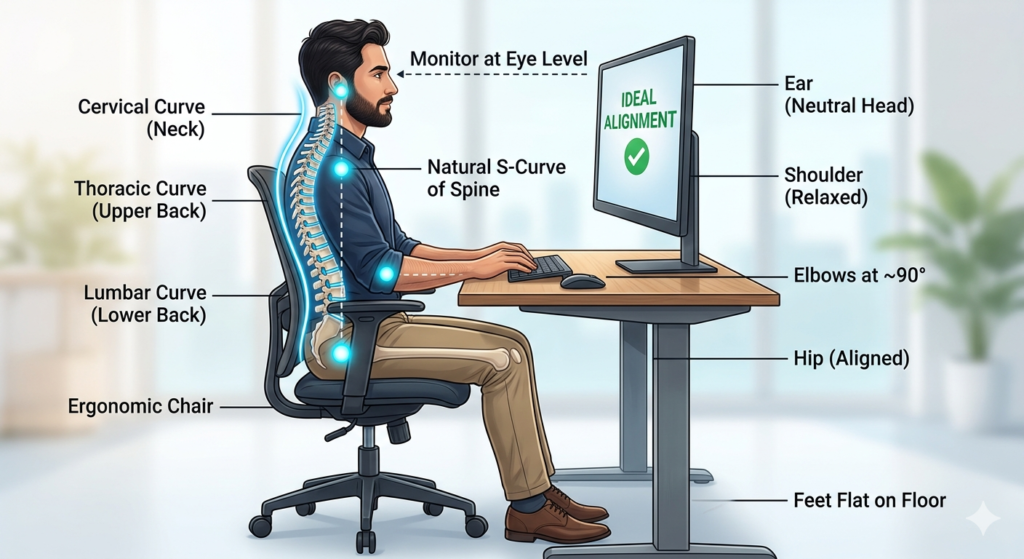
What is neutral posture? Neutral posture is a resting physical state where the body is perfectly aligned and balanced against gravity. In this position, muscular effort is minimized, spinal alignment is optimized, and stress on tendons, ligaments, and joints is reduced to its absolute lowest possible level.
When you sit outside of this neutral zone, your body compensates. A head positioned just a few inches forward can quadruple the workload on your neck muscles. Achieving neutrality means allowing your skeletal structure to do the heavy lifting, rather than your soft tissues.
The Science of Joint Stacking
To understand neutrality, you must understand the concept of joint stacking. In biomechanics, the human body is most stable when its major load-bearing joints are vertically aligned.
- The Vertical Line: In a perfect seated posture, an invisible plumb line should drop straight down from your ear opening, pass through the center of your shoulder joint, and land directly in the center of your hip.
- Structural Support: When these joints are stacked, your bones bear the weight of your body. When they are unstacked (such as when you lean forward to read a screen), your muscles must fire constantly to prevent you from falling over.
By stacking your joints, you effectively turn off the “emergency brakes” in your back and neck, allowing those muscles to relax entirely.
Breaking Down the 90-90-90 Rule
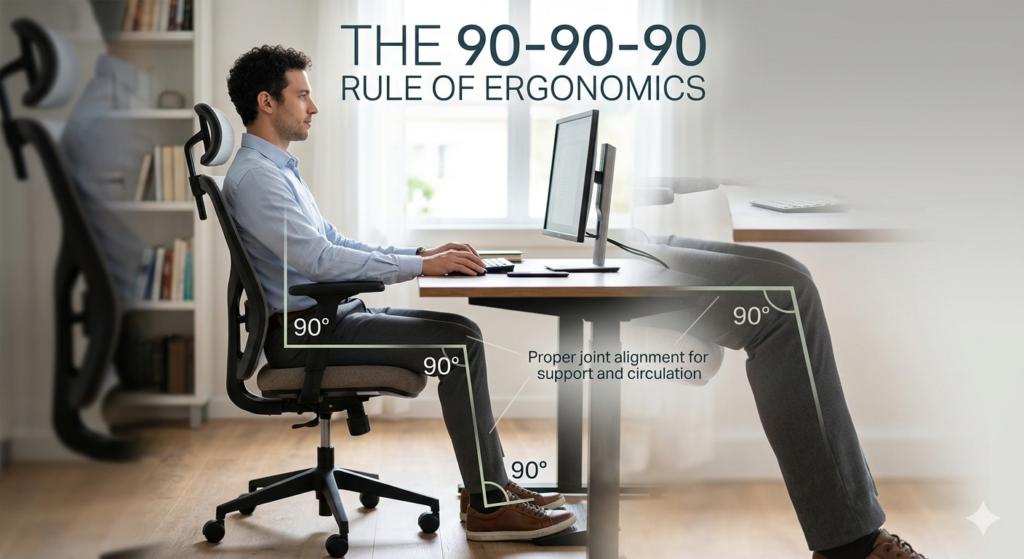
The most practical way to achieve joint stacking in a chair is by applying the 90-90-90 rule. This rule dictates the specific angles your lower body should form to establish a solid foundation for your spine.
The First 90: Hips and Pelvis
Your torso and your thighs should form a 90-degree (or slightly open, up to 100-degree) angle. This requires sitting all the way back in your chair so your lumbar spine is supported by the backrest.
The Second 90: The Knees
Your lower legs should form a 90-degree angle with your thighs. The back of your knees should have a small gap (about two to three fingers wide) between the calf and the edge of the seat pan. This gap ensures you are not cutting off blood flow to your lower extremities.
The Third 90: The Ankles
Your feet and your shins must form the final 90-degree angle, requiring your feet to be planted firmly and flatly on the floor.
If your chair is raised to accommodate a high desk, your feet may dangle. Allowing your feet to hang pulls your pelvis forward and ruins your spinal alignment. To fix this, place a firm platform beneath your soles to restore the 90-degree ankle angle and fully support your legs.
Maintaining Spinal Alignment and Upper Body Neutrality
Once the lower body is set via the 90-90-90 rule, maintaining spinal alignment becomes much easier. The human spine is not a straight pole; it has a natural “S” shape.
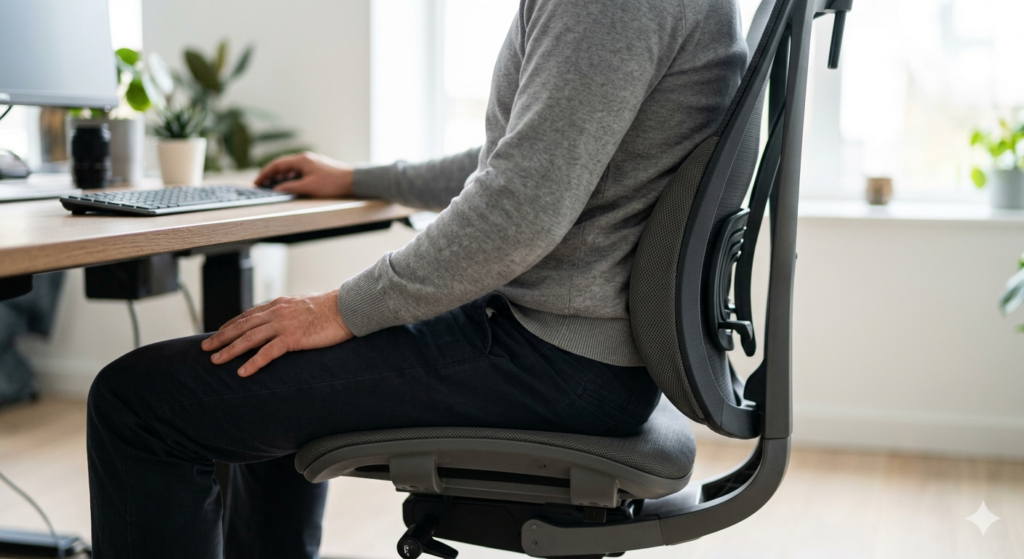
The lower back (lumbar region) curves inward, the mid-back (thoracic region) curves outward, and the neck (cervical region) curves inward again. A neutral posture respects and supports these curves. Your chair’s lumbar support should fill the gap in your lower back, preventing your pelvis from rolling backward into a slouch.
Finally, allow your upper arms to hang naturally at your sides. Your elbows should bend at roughly 90 degrees to reach your keyboard, keeping your shoulders depressed and relaxed.
Conclusion
Mastering your desk environment begins with your own body. By answering the question of what is neutral posture, you equip yourself with the mechanical blueprint for a pain-free workday. Implementing the 90-90-90 rule ensures that your hips, knees, and ankles provide a stable foundation, promoting proper joint stacking and a healthy, supported spine. When you sit in harmony with gravity, you protect your long-term health and drastically increase your daily comfort.
Frequently Asked Questions (FAQ)
What is the 90-90-90 rule in ergonomics?
The 90-90-90 rule is an ergonomic guideline suggesting that when seated, your hips, knees, and ankles should all be positioned at roughly 90-degree angles. This ensures the body is mechanically supported and balanced.
How do you maintain a neutral spine while sitting?
To maintain a neutral spine, sit all the way back in your chair so the backrest supports your natural lumbar curve. Keep your feet flat on the floor to stabilize your pelvis, and keep your ears aligned directly over your shoulders.
Is it bad to cross your legs at a desk?
Yes. Crossing your legs twists your pelvis, misaligns your spine, and can restrict blood flow in your lower legs. It breaks the 90-90-90 rule and pulls your body completely out of neutral posture.
Can I lean back while maintaining neutral posture?
Yes. In fact, opening your hip angle slightly to 100 or 110 degrees by leaning back in a supportive chair can reduce disc pressure in your lower back, as long as your spine remains straight and your joints remain stacked.