Traditional office ergonomics have historically focused on providing the body with maximum external support. The goal was to build chairs that hold you in a rigid, perfect posture, completely offloading the physical work from your muscles. However, sports science and biomechanics have begun to challenge this static approach, noting that absolute stillness often leads to profound muscular atrophy and afternoon fatigue.
Enter the concept of active sitting. This alternative approach flips traditional ergonomics on its head. Instead of relying on a chair to hold you up, it forces your body to support itself through continuous, subtle movement.
If you find yourself feeling lethargic or stiff despite having a highly-rated ergonomic chair, your body might be craving motion rather than rest. This guide explores the definition of this seating method, how it impacts your core musculature, and how to safely incorporate it into your daily routine.
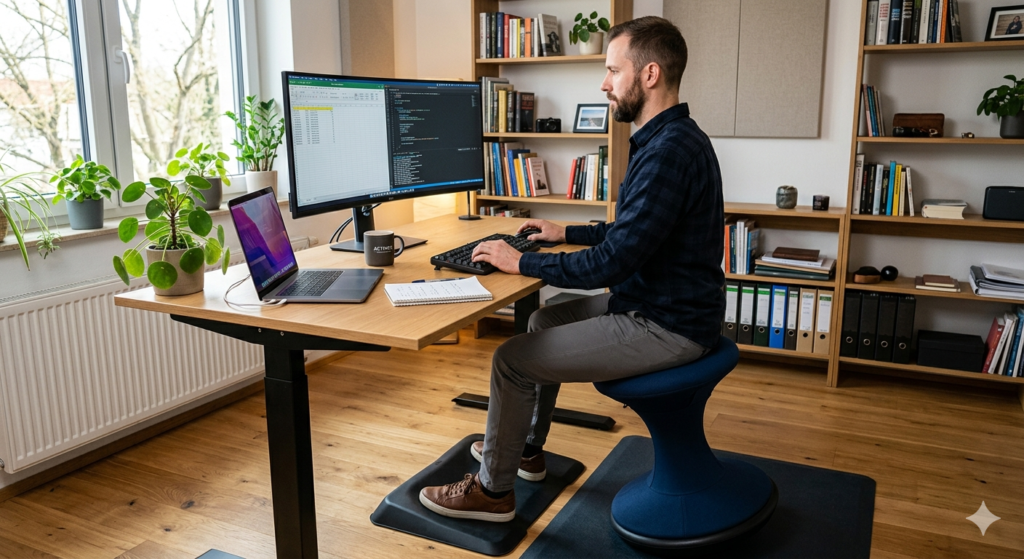
The Mechanics of Active Sitting
What is active sitting? Active sitting, also known as dynamic sitting, is an ergonomic practice that requires the user to continuously engage their muscles to remain upright. By utilizing intentionally unstable surfaces, it promotes micro-movements, enhances core strength, stimulates blood flow, and prevents musculoskeletal stagnation.
When you sit in a standard chair with a high backrest and armrests, your core muscles effectively turn off. Your skeletal structure relies entirely on the foam and plastic of the chair to fight gravity. Over an eight-hour shift, this leads to a sluggish metabolism and shortened, tight muscles.
Dynamic sitting introduces a controlled level of instability. Because the seat does not hold you in a fixed position, your body must constantly make tiny adjustments to balance itself.
Core Engagement and Postural Health
The primary physiological benefit of this practice is sustained core engagement. The core is not just your visible abdominal muscles; it includes the deep stabilizing muscles that wrap around your lower spine and pelvis.
When you sit on an unstable surface, your nervous system continuously fires these deep stabilizers to prevent you from tipping over. This low-level muscular endurance training naturally improves your posture. As we highlighted in our comprehensive guide, Workspace Wellness: Building a Routine for Longevity, introducing regular micro-movements is essential for maintaining physical stamina during long shifts.
Furthermore, these continuous micro-movements manually pump spinal fluid through your intervertebral discs. This keeps your spinal column hydrated and drastically reduces the compressive ache often associated with prolonged static sitting.
Exploring Alternative Seating Methods
To practice this habit, you must remove the external support of a standard chair. There are several specialized seating tools designed specifically to facilitate this movement.
The Wobble Stool
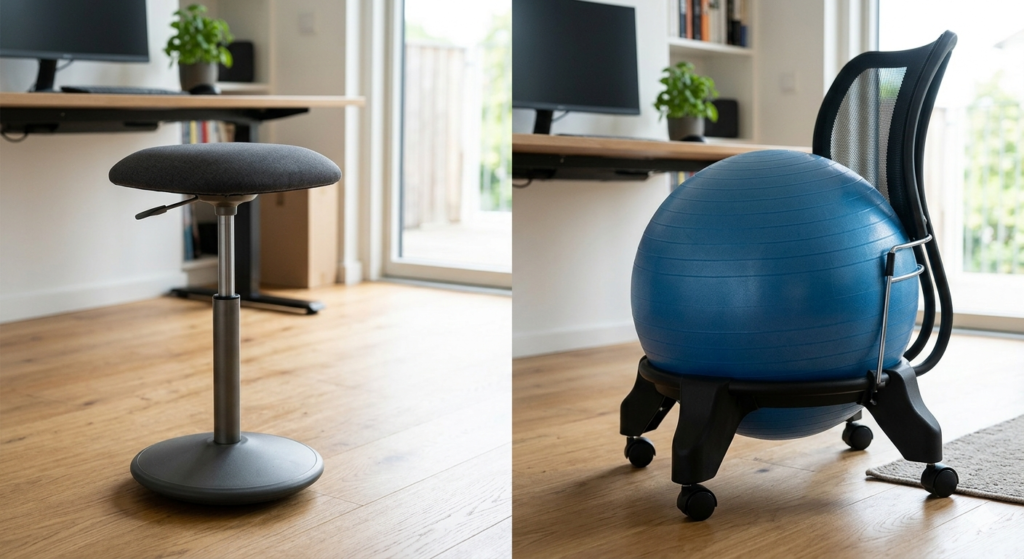
A wobble stool features a rounded or flexible base that allows the seat pad to tilt, pivot, and rotate in 360 degrees. It forces the user to plant their feet firmly on the ground to control the angle of the seat. This is an excellent tool for sit-stand desks, as it allows you to lean comfortably while keeping your legs and core highly active.
The Balance Ball
Perhaps the most recognizable alternative seat is the large, inflatable balance ball (often called a Swiss ball or stability ball). Because it is filled with air, the surface reacts instantly to every shift in your body weight. Swapping out your static chair for a balance ball chair for 20 to 30 minutes a day introduces gentle, bouncy instability, forcing your abdominal muscles to fire constantly to keep your spine vertically aligned.
Should You Try It? Transitioning Safely
While the benefits of an active core are clear, dynamic seating should be viewed as an exercise supplement, not a full-time replacement for your primary ergonomic chair. The human body is not conditioned to balance perfectly for eight consecutive hours.
If you attempt to use an unstable seat for your entire workday, your core muscles will eventually fail from exhaustion. Once those stabilizers tire out, you will inevitably collapse into a severe, unsupported slouch, placing immense pressure on your lower spine.
To incorporate this safely, practice interval seating. Keep your standard, supportive ergonomic chair for deep, focused work. Pull out your active seat for just 20 to 30 minutes at a time, perhaps while answering emails or taking a phone call, to wake up your nervous system and stimulate blood flow.
Conclusion
Active sitting represents a fundamental shift in how we approach workspace health. By intentionally removing external back support and embracing unstable seating, you can transform a sedentary habit into an opportunity for mild physical conditioning. Utilizing tools like wobble stools or stability balls encourages continuous core engagement and essential micro-movements. Treat this practice as a valuable supplement to your daily routine, and enjoy the physical vitality that comes from keeping your body in motion.
Frequently Asked Questions (FAQ)
Does active sitting burn more calories?
Yes, but the difference is marginal. Dynamic sitting burns approximately 10 to 20% more calories than passive sitting due to the constant low-level engagement of your stabilizing muscles. However, it is not a replacement for traditional cardiovascular exercise.
Can I use a balance ball as my only desk chair?
It is highly discouraged to use a balance ball as your full-time chair. Without a backrest, your core muscles will inevitably fatigue after an hour or two, leading to severe postural collapse and lower back pain. It should be used in short intervals.
Is active sitting good for lower back pain?
It can be beneficial for lower back pain caused by stiffness and lack of movement, as it hydrates the spinal discs and strengthens the supporting muscles. However, if you have an acute spinal injury or herniated disc, the instability may aggravate the condition.
What is the difference between active and passive sitting?
Passive sitting involves relying entirely on the chair’s structure (backrest, armrests, and headrest) to hold your body upright, requiring zero muscular effort. Active sitting requires your own muscles (primarily the core and back) to balance and support your spine.