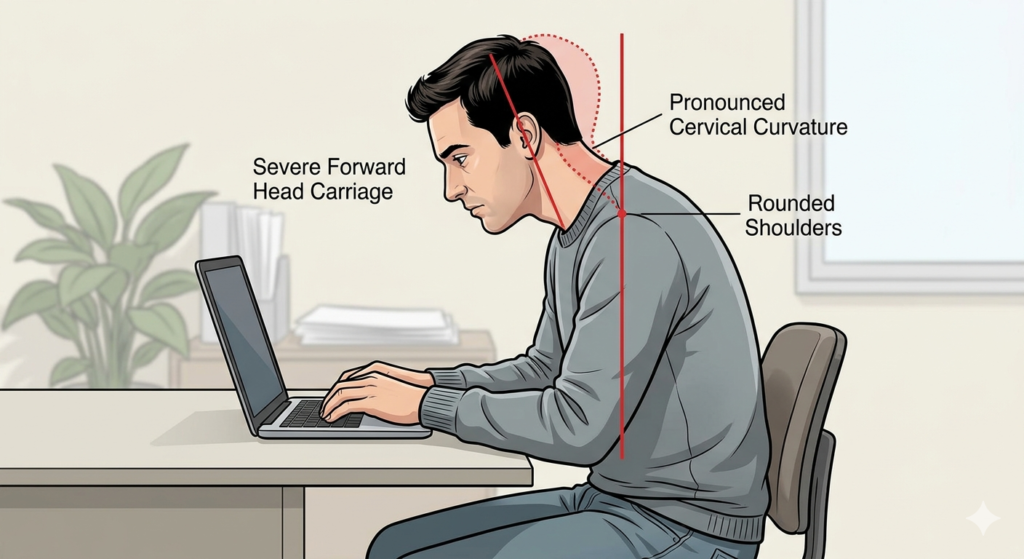
Staring at a computer screen for eight hours a day often has visible physical consequences. One of the most common and problematic is the dreaded “turtle neck” appearance. As we lean in to read small text or hunch over laptops, our heads slowly drift forward, out of alignment with our shoulders. Over time, this forward carriage becomes our default resting position.
This condition does more than alter your appearance; it drastically alters your biomechanics. The farther your head moves forward, the heavier it becomes relative to your spine, leading to chronic tension, stiffness, and persistent headaches.
This guide provides a practical troubleshooting routine. We will explore the mechanical causes of this posture and outline simple, effective exercises to reverse it and relieve the associated tension.
The Mechanics of Tech Neck
To fix forward head posture, you must address the muscular imbalance in your cervical spine. “Tech neck” occurs when the deep neck flexors weaken and the suboccipital muscles tighten, pulling the head forward and exponentially increasing the weight borne by your neck.
An average human head weighs roughly 10 to 12 pounds when perfectly balanced over the shoulders. For every single inch your head moves forward, the mechanical load on your neck and upper back muscles increases by 10 pounds. A posture that is three inches forward forces the muscles to support a functional weight of over 40 pounds simply to keep your eyes level.
This constant strain exhausts the soft tissues, leading to inflammation and reduced mobility.
Exercise 1: The Foundation of Neck Retraction
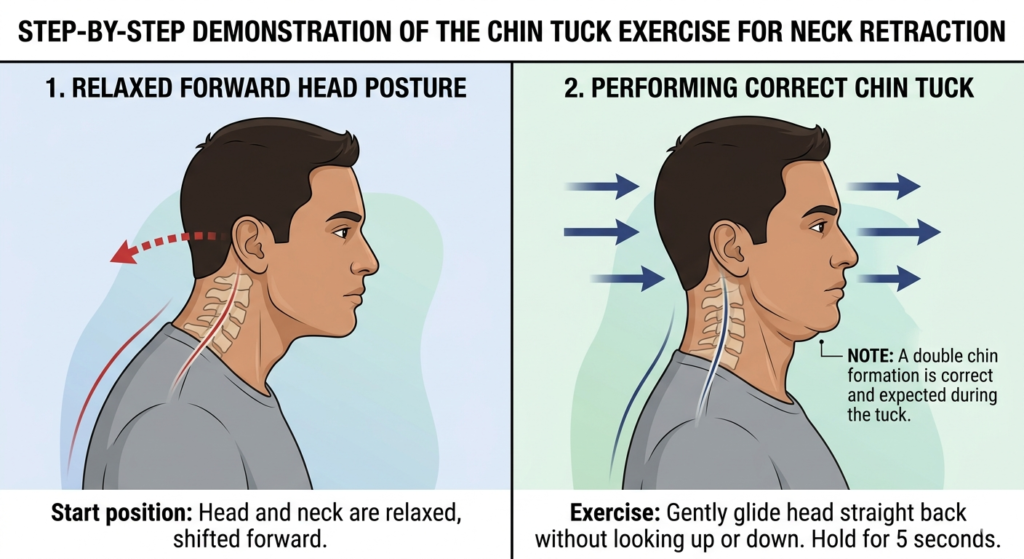
The most critical movement for correcting a forward head is neck retraction. This is not about looking up at the ceiling; it is about gliding the skull straight back horizontally to align it over the torso.
How to Perform Chin Tucks
The chin tuck is the gold standard for strengthening the weakened deep cervical flexors at the front of the neck while stretching the tight muscles at the base of the skull.
- Sit up straight in your chair or stand with your back against a wall.
- Keep your chin perfectly level with the floor. Do not tilt your head backward.
- Gently pull your head and chin straight back, as if you are trying to make a “double chin” or pull your head away from a bad smell.
- Hold this retracted position for 3 to 5 seconds, then relax.
- Repeat for 10 repetitions, twice a day.
Exercise 2: Strengthening the Upper Back
Forward head posture rarely happens in isolation. It is almost always part of a broader postural collapse that includes rounded shoulders. As detailed in our guide, Neutral Posture Explained: The Science of the 90-90-90 Rule, maintaining proper spinal alignment requires the entire kinetic chain to be balanced.
To permanently hold your head back, you must build endurance in the muscles between your shoulder blades (the rhomboids and lower trapezius).
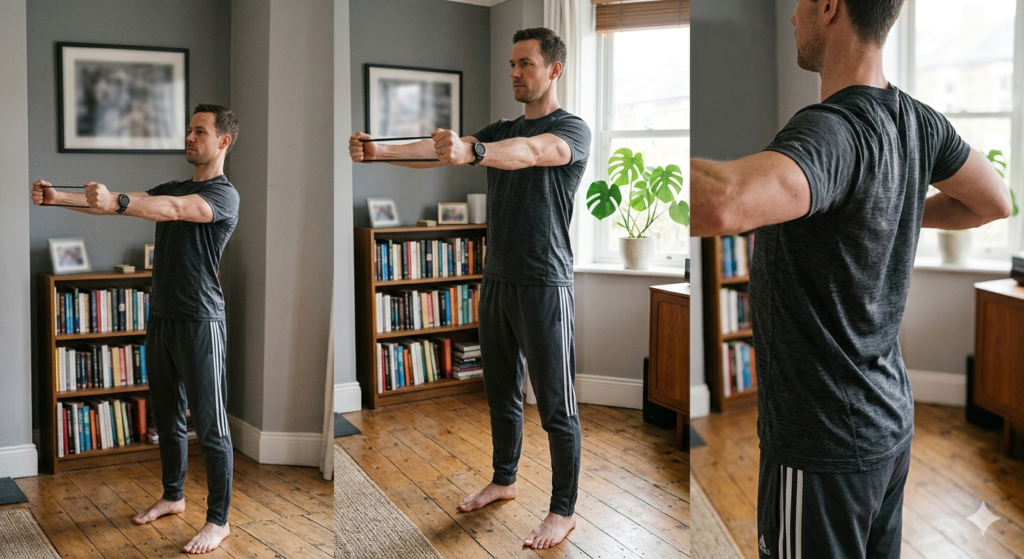
Scapular Retractions (Band Pull-Aparts)
This exercise wakes up the dormant muscles of the upper back, giving them the strength to counteract the forward pull of your chest and head.
- Stand up straight and hold a light elastic tool in front of you with both hands at chest height. Utilizing resistance bands provides excellent, progressive tension for this movement.
- Keep your arms straight, but do not lock your elbows.
- Pull your hands apart by squeezing your shoulder blades together. Imagine trying to crush a pencil between your shoulder blades.
- Hold the squeeze for 2 seconds, then slowly return to the starting position.
- Perform 2 sets of 15 repetitions daily.
Exercise 3: Stretching the Tight Chest Muscles
When your head and shoulders drift forward for long periods, your chest muscles (pectorals) physically shorten and adapt to this collapsed position. If you do not stretch these tight tissues, they will continuously pull your framework forward, undoing the strengthening work you just completed.
The Doorway Stretch
This passive stretch gently opens the chest cavity, allowing the shoulders to drop back and providing a stable base for the cervical spine.
- Stand in an open doorway.
- Raise your arms and place your forearms flat on the doorframe. Your elbows should be bent at 90 degrees and positioned at shoulder height.
- Keep your core engaged to protect your lower back, and gently step one foot forward.
- Lean into the doorway until you feel a deep stretch across your chest and the front of your shoulders.
- Hold this stretch for 30 seconds. Do not bounce. Breathe deeply and allow the muscles to release.
Conclusion
Overcoming the “turtle neck” posture is not an overnight process. It requires consistent, daily effort to retrain the muscles of your cervical spine and upper back. By understanding the heavy mechanical toll of tech neck and actively combating it with targeted chin tucks, scapular retractions, and chest stretches, you can slowly restore your natural alignment. Taking a few minutes each day to fix forward head posture will significantly reduce chronic pain, eliminate tension headaches, and improve your overall structural health at the desk.
Frequently Asked Questions (FAQ)
How long does it take to fix forward head posture?
The timeline varies depending on the severity of the posture and how consistently you perform corrective exercises. With daily stretching and strengthening, most people begin to feel a reduction in neck tension within 2 to 4 weeks, with visible postural changes occurring over 3 to 6 months.
Can forward head posture cause headaches?
Yes. Forward head posture places immense strain on the suboccipital muscles at the base of the skull. When these muscles become tight and inflamed, they can compress the suboccipital nerves, leading to frequent tension headaches that radiate from the back of the neck to the forehead.
Do posture correctors fix tech neck?
Wearable posture correctors can provide temporary awareness and gently pull the shoulders back, but they do not “fix” tech neck on their own. Relying solely on a brace can actually weaken your stabilizing muscles over time. Corrective exercises are required for long-term improvement.
Is it too late to fix my forward head posture?
In the vast majority of cases, it is never too late to improve forward head posture. While severe, long-term misalignments may have caused structural changes in older adults, targeted exercises will almost always improve mobility, reduce pain, and restore a more neutral head carriage.