Catching a glimpse of your profile in a mirror and noticing a pronounced slouch can be a frustrating realization. For many desk workers, the shoulders slowly creep forward over months and years, fundamentally altering the shape of the upper body. This structural shift is rarely an intentional posture choice; rather, it is a physical adaptation to your daily environment.
If you want to permanently fix rounded shoulders, simply trying to “stand up straight” will not work. Your muscles have physically adapted to a forward-leaning position, making proper alignment feel exhausting.
This troubleshooting guide explores the physiological reasons behind this postural collapse. We will break down the mechanics of the slouch and provide objective, actionable steps to restore balance to your upper body.
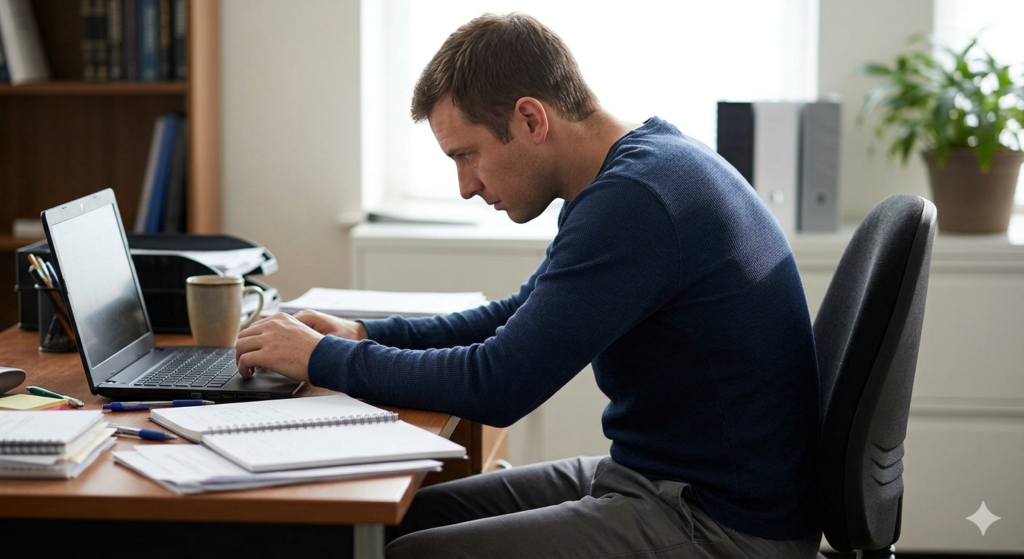
The Biomechanics of Slouching
To fix rounded shoulders, you must first understand upper cross syndrome. This postural imbalance occurs when chest muscles become overly tight and back muscles become weak and elongated. It pulls the shoulders forward, locking the upper body into a permanent, energy-draining slouch.
When you sit with your arms extended toward a keyboard for eight hours a day, the pectoral muscles on the front of your body remain in a shortened state. Because the human body is highly adaptive, these “chest tighteners” eventually lose their flexibility and permanently pull your shoulder blades forward and away from the spine.
Simultaneously, the muscles on your upper back are stretched tight and become dormant. They lose the structural tension required to hold your joints in a neutral position.
Why Desk Work Exacerbates the Problem
The physical layout of a standard workstation practically mandates poor posture. Unless you actively manage your environment, your body will follow the path of least resistance, which is usually a forward collapse.
When a monitor is placed too low or a keyboard is positioned too far away, gravity pulls your torso down. As detailed in our foundational guide, Neutral Posture Explained: The Science of the 90-90-90 Rule, a misalignment in one part of the spine cascades to the rest of the body. If your lower back loses its natural curve, your upper back must round out to compensate, pushing your shoulders further out of alignment.
This continuous forward reach functionally glues your shoulder blades to the sides of your ribcage, severely limiting your range of motion over time.
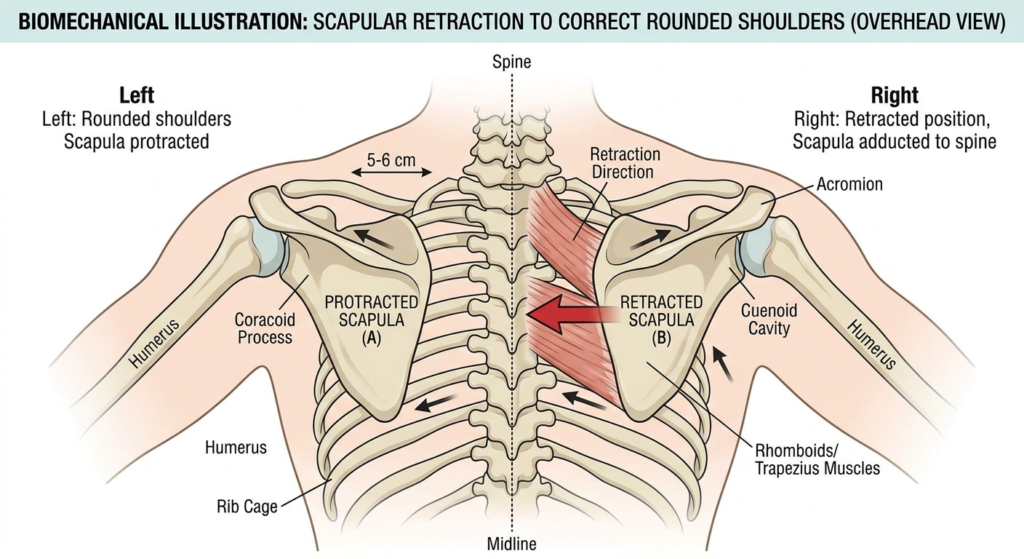
Reversing the Pattern: Scapular Retraction
The primary mechanical antidote to this forward rotation is a movement called scapular retraction. This is the physical action of pulling your shoulder blades back and down toward your spine.
To reverse upper cross syndrome, you must actively train your nervous system to engage the rhomboids and lower trapezius muscles. These are the muscles responsible for holding the scapulae in place.
Building physical awareness (proprioception) of where your shoulders are in space is half the battle. When deep in a work task, it is easy to forget your posture and revert to slouching. Utilizing a lightweight physical cue can provide the necessary tactile feedback to remind your brain to engage those back muscles whenever you start to lean forward.
Daily Habits to Straighten Up
Fixing this muscular imbalance requires a two-pronged approach: stretching the tight muscles on the front and strengthening the weak muscles on the back.
- Open the Chest: You must regularly stretch your pectoral muscles to release the tension pulling your shoulders forward. Simple doorway stretches performed for 30 seconds multiple times a day can help restore tissue length.
- Strengthen the Upper Back: Incorporate pulling movements into your daily routine. Resistance band pull-aparts or seated rows effectively build endurance in the muscles responsible for scapular retraction.
- Optimize the Desk: Bring your keyboard closer to the edge of the desk so your elbows can rest comfortably at your sides. This immediately removes the need to reach forward, stopping the slouch at its source.
Conclusion
Correcting years of poor posture is not an overnight fix, but it is highly achievable with consistent biomechanical adjustments. By understanding upper cross syndrome and actively working to stretch chest tighteners while strengthening the back, you can successfully fix rounded shoulders. Prioritize scapular retraction throughout your workday, and over time, your body will adapt to a healthy, upright alignment that requires zero conscious effort to maintain.
Frequently Asked Questions (FAQ)
What is upper cross syndrome?
Upper cross syndrome is a specific muscle imbalance pattern where tight chest and neck muscles cross with weak upper back and deep neck flexor muscles, resulting in a forward head and rounded shoulder posture.
Can rounded shoulders be fixed permanently?
Yes, in the vast majority of cases, rounded shoulders can be fixed permanently. It requires a consistent routine of stretching the chest, strengthening the upper back, and adjusting your daily ergonomic environment to prevent a recurrence.
Does slouching cause back pain?
Yes. Slouching forces the muscles, ligaments, and spinal discs to bear weight unevenly. This chronic mechanical stress leads to muscular fatigue, tension knots between the shoulder blades, and lower back aches.
How long does it take to correct rounded shoulders?
Depending on the severity of the muscle tightness, noticeable improvements in posture and reductions in pain can occur within 4 to 6 weeks of consistent daily stretching and strengthening. Structural changes to resting posture may take several months.