Upgrading to an adjustable desk is only half the battle. Once you have the equipment, the immediate challenge becomes knowing exactly when and how often to use it. Many new users fall into one of two extremes: they either stand for four hours straight until their feet throb, or they leave the desk in the seated position for weeks at a time.
Neither approach is healthy. The true value of an adjustable workstation is found in continuous, low-level physical transitions. To maximize the health benefits and maintain your focus, you must approach your posture like a schedule.
This guide explores the metrics for optimizing your daily movement. We will break down the precise timing required to prevent physical strain and introduce reliable frameworks for keeping your body active throughout the workday.
Defining the Optimal Balance
What is the ideal sit-stand ratio? The ideal sit-stand ratio is a structured ergonomic schedule that alternates between sitting, standing, and moving to prevent physical strain. A suggested baseline is spending roughly 60% of your time sitting, 30% standing, and 10% moving throughout the workday.
The specific minutes do not have to be rigid, but the principle of frequent rotation is non-negotiable. Sitting all day causes lumbar compression, while standing all day causes joint fatigue. Alternating between the two mitigates the negative effects of both.
The Science of the 20-8-2 Rule
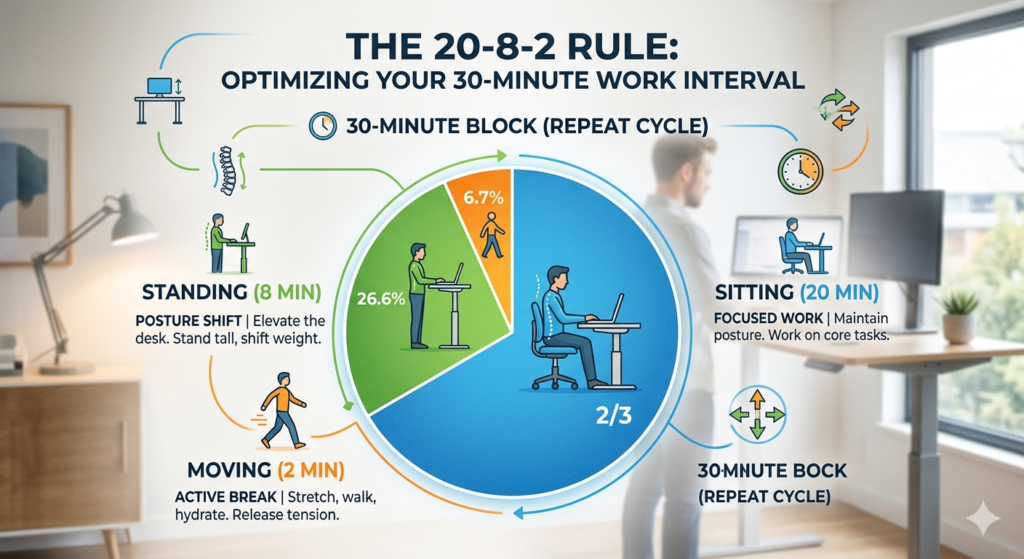
One of the most widely respected frameworks for structuring this ratio was developed by Dr. Alan Hedge, an ergonomics researcher at Cornell University. This framework is commonly known as the 20-8-2 rule.
It breaks down every half hour of your workday into three distinct phases:
- Sit for 20 minutes: Use this time in a perfectly supported, neutral posture.
- Stand for 8 minutes: Elevate the desk to engage your core, stimulate blood flow, and stretch your hip flexors.
- Move for 2 minutes: Step completely away from the desk. Walk to get water, do a quick stretch, or pace during a phone call.
This method of interval working is highly effective because it prevents blood from pooling in the lower extremities while ensuring your muscles receive regular, short bursts of oxygen without becoming exhausted.
Recognizing and Preventing Standing Fatigue
While the 20-8-2 rule is a fantastic baseline, you must also learn to listen to your body’s mechanical limits. The human body is not designed to stand perfectly still on a flat, hard surface for extended periods.
When you push past your physical conditioning, you experience standing fatigue. This manifests as aching heels, lower back stiffness, and a heavy feeling in your calves. As outlined in our foundational guide on The Complete Guide to Standing Desk Benefits and Transitioning, the goal is dynamic movement, not static endurance.
If you find yourself exhibiting the following behaviors, your body is telling you that your standing interval is over:
- Constantly shifting your weight from one leg to the other.
- Locking your knees backward (hyperextension).
- Leaning heavily on the desk surface with your elbows to support your torso.
When you notice these signs, immediately lower the desk. Pushing through standing fatigue simply trades the pain of sitting for the pain of standing.
Implementing Interval Working Smoothly
The biggest obstacle to maintaining a healthy sit-stand ratio is human memory. When you enter a state of deep focus, or “flow,” hours can pass without you realizing that you have not moved a muscle.
To make interval working a sustainable habit, you must automate the reminders. Do not rely on willpower or memory to tell you when to stand up. Utilizing a simple desktop timer allows you to set gentle, unobtrusive alerts that prompt you to change your posture at specific intervals.
Additionally, try to sync your physical transitions with your task transitions. For example, stand up when reading emails or taking phone calls, and sit down when engaging in deep writing or complex coding.
Conclusion
Finding your ideal sit-stand ratio is about establishing a sustainable rhythm of movement. By adopting frameworks like the 20-8-2 rule, you ensure your body experiences the cardiovascular benefits of standing without succumbing to the joint strain of standing fatigue. Remember that interval working should feel natural and restorative. Utilize timers to keep yourself on track, and view regular movement breaks not as interruptions to your workflow, but as essential maintenance for your body and your focus.
Frequently Asked Questions (FAQ)
Is standing for 2 hours a day enough?
Yes, standing for two accumulated hours throughout an 8-hour workday is an excellent and realistic goal for most people. The key is to break those two hours up into smaller, 10 to 15-minute intervals rather than standing for two hours straight.
Why do my feet hurt when using a standing desk?
Foot pain is typically caused by standing fatigue, wearing unsupportive footwear (or working barefoot on hard floors), or standing for intervals that are simply too long for your current level of physical conditioning.
Can I use the Pomodoro technique for standing?
Absolutely. The Pomodoro technique (working for 25 minutes, resting for 5 minutes) aligns perfectly with sit-stand intervals. You can sit for one 25-minute sprint, and then stand for the next 25-minute sprint, using the 5-minute break to walk away from the desk.
Should I stand immediately after eating lunch?
Yes. Standing or taking a short walk immediately after a meal is highly recommended. Light muscular activity helps your body process glucose more efficiently, which can prevent the drastic blood sugar spikes and crashes that cause afternoon sluggishness.