Being exceptionally tall has its advantages, but seamlessly fitting into a standard corporate workspace is rarely one of them. The vast majority of office furniture is manufactured to accommodate the statistical average, which typically tops out around 5’10”. If you are 6’2″ or taller, sitting at a standard workstation often feels like trying to fold yourself into a child’s desk.
Working in an environment built for a smaller body forces you to unconsciously hunch your shoulders, splay your legs awkwardly, and crane your neck downward to view your screens. Over time, these micro-compensations lead to chronic lower back pain and severe cervical spine tension.
Proper ergonomics for tall people requires looking past “standard” furniture sizes and seeking out specialized modifications. This niche guide explores the specific measurements, hardware adjustments, and structural requirements necessary to build a workspace that actually supports a taller stature.
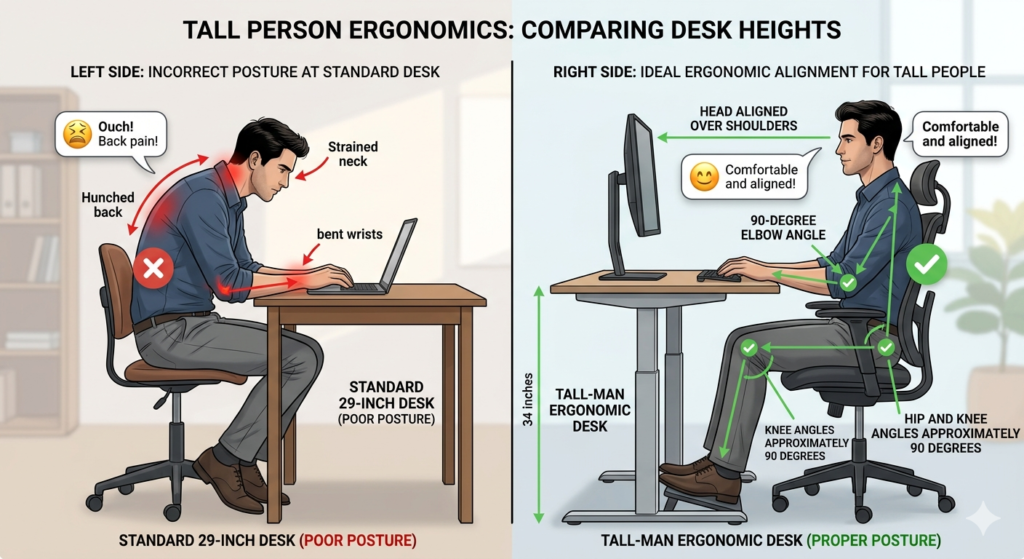
Understanding Biomechanics for a Huge Frame
What is ergonomics for tall people? Ergonomics for tall people is the specific adjustment of workspace furniture to accommodate a larger skeletal structure. It involves utilizing extended chair cylinders, deeper seat pans, and heightened desk surfaces to ensure proper joint stacking, adequate knee clearance, and neutral spinal alignment.
When you possess a huge frame, your levers (arms and legs) are longer. This means that a slight misalignment in your chair or desk height creates a much larger torque on your joints than it would for a shorter person. Achieving a neutral posture requires furniture that can extend to match these longer levers.
Chair Adjustments: Modifying the Foundation
The standard office chair is the first point of failure for a tall user. If your chair does not fit your body, no amount of desk adjustment will save your posture.
The Need for a Cylinder Extension
Most standard office chairs have a maximum seat height of around 19 to 20 inches. For a tall person, this leaves the knees resting higher than the hips, which flattens the lower back and drastically increases spinal compression.
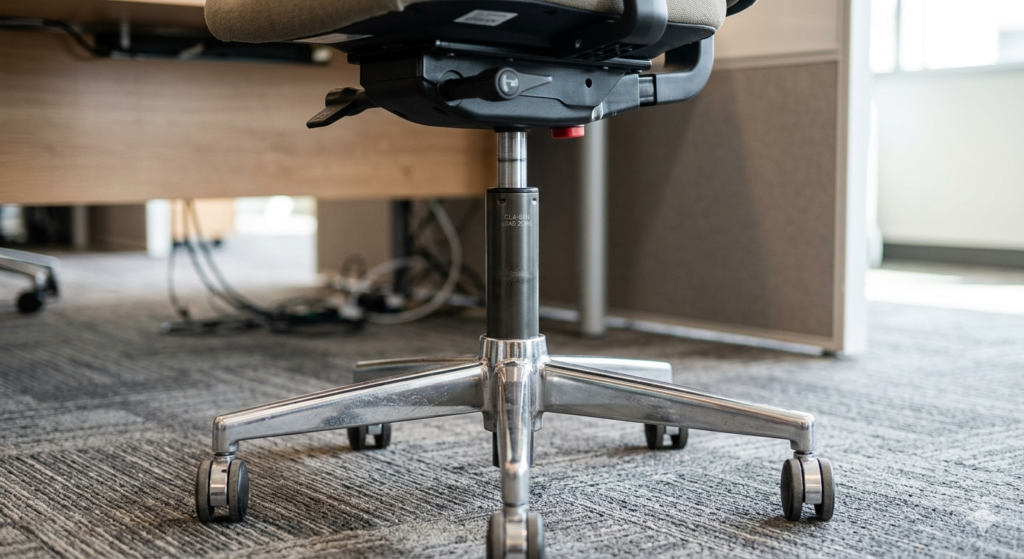
To achieve the ideal posture (feet flat on the floor with hips slightly above the knees), you must increase the chair’s maximum height. This is easily done by swapping the standard gas lift mechanism with a heavy-duty cylinder extension. An extended “tall” cylinder can raise your maximum seat height to 22 or 24 inches, instantly restoring your mechanical leverage and hip alignment.
Seat Pan Depth and Leg Support
Tall individuals typically have longer femurs (thigh bones). A standard 17-inch seat pan will only support half of a long thigh, leaving the rest of the leg hanging unsupported and creating massive pressure points on the sitting bones.
You must look for a chair with an adjustable seat slider that extends the depth to at least 19 or 20 inches. This provides full support for your thighs while still maintaining a healthy two-inch gap behind the knee.
Elevating the Work Surface
The industry standard for desk height is 29 to 30 inches. If you are over 6’2″, sitting at a 29-inch desk usually means your thighs are jammed against the underside of the tabletop, and you must physically stoop forward to reach your keyboard.
Securing Adequate Knee Clearance
When you raise your chair with a cylinder extension, you must also raise your desk to maintain proper knee clearance. You need enough space to comfortably cross your legs or shift your weight without bruising your kneecaps on the desk frame or under-desk keyboard trays.
Raising a Standard Desk
If purchasing a custom-built, extra-tall desk is not an option, you can modify your existing furniture. Safely elevating the desk legs with heavy-duty structural supports can lift the entire work surface by 3 to 5 inches. This places your keyboard exactly at your resting elbow height, eliminating the need to slouch forward.
This height principle is equally crucial when you decide to stand. As detailed in our comprehensive breakdown, The Complete Guide to Standing Desk Benefits and Transitioning, ensuring the desk surface meets your elbows perfectly is the only way to prevent severe upper back tension during upright work.
Overcoming Monitor Height Limits
Because tall individuals have longer torsos, their resting eye level is much higher than average. The stands included in the box with most computer monitors are woefully inadequate for this demographic.
Even when adjusted to their maximum height, standard stands often leave the top of the screen at a tall person’s chest level. This physical limitation forces the user to look down at a sharp angle, resulting in severe “tech neck.”
To beat these monitor height limits, you must utilize an aftermarket VESA mount with an extra-tall central pole. A standard 16-inch pole will not suffice; look for poles that are 24 to 32 inches tall. This allows you to slide the monitor brackets high enough so that the top bezel of the screen aligns perfectly with your natural, upright gaze.
Conclusion
You should not have to endure daily physical pain simply because you fall outside the standard manufacturing average. By applying the rules of ergonomics for tall people, you can stop contorting your body to fit your workspace. Upgrading your chair with a taller cylinder, deepening your seat pan, elevating your desk surface, and utilizing extended monitor mounts are vital steps in accommodating a larger frame. When your environment actually matches your dimensions, you can work comfortably and protect your long-term spinal health.
Frequently Asked Questions (FAQ)
What is the ideal desk height for someone who is 6’3″ or taller?
While it varies based on exact torso and arm length, most people over 6’3″ require a seated desk height between 31 and 33 inches to comfortably accommodate their knees and allow their elbows to rest at a 90-degree angle.
Do standing desks go high enough for tall people?
Many budget standing desks max out around 45 to 47 inches, which is often too short for someone over 6’2″. Tall individuals should look for dual-stage or three-stage standing desks that offer a maximum height of at least 50 inches.
How do I know if my office chair seat pan is deep enough?
Sit all the way back in your chair so your lumbar spine is supported. You should be able to fit exactly two to three fingers between the front edge of the seat cushion and the back of your knees. If the gap is larger than a full hand’s width, the seat is too shallow for your legs.
Can I replace the cylinder on any office chair?
Yes, the pneumatic gas cylinders on the vast majority of standard office chairs are universally sized at the connection points (typically 50mm or 2 inches in diameter). You can safely tap out the old cylinder with a rubber mallet and drop in a taller replacement.