Upgrading to an adjustable workstation is an exciting step toward better health, but the first week is often a painful reality check. Many enthusiastic users press the “up” button on Monday morning, intending to stand all day, only to find themselves sitting down by noon with throbbing heels and a stiff lower back.
This immediate discomfort is not a sign that standing is bad for you; it is a sign that you have skipped the conditioning phase. Your body has likely spent years adapting to the passive mechanics of sitting. Forcing those dormant stabilizing muscles to suddenly hold you upright for eight hours is a recipe for severe musculoskeletal exhaustion.
This guide provides a structured, 4-week schedule for your physical transition. We will explore the principles of progressive loading and provide a clear roadmap for breaking in your body without suffering from debilitating fatigue.
The Biomechanics of a Standing Desk Transition
What is a standing desk transition? A standing desk transition is the gradual process of adapting your body to upright work through progressive loading. It involves slowly increasing standing intervals over several weeks to build muscular endurance, prevent joint strain, and safely acclimate the cardiovascular system.
Just as you would not run a marathon without training, you should not attempt to stand for an entire workday without conditioning. This process relies on progressive loading—the biomechanical principle of slowly increasing the mechanical stress on your tissues so they can adapt and grow stronger over time.
When you stand, the muscles in your feet, calves, and lower back must fire continuously. By breaking your standing time into short, manageable blocks, you allow these tissues to rebuild during seated recovery periods.
Weeks 1 & 2: Breaking In Your Body
The primary goal of the first two weeks is neuromuscular adaptation. You are simply waking up dormant muscles and getting your joints accustomed to bearing weight.
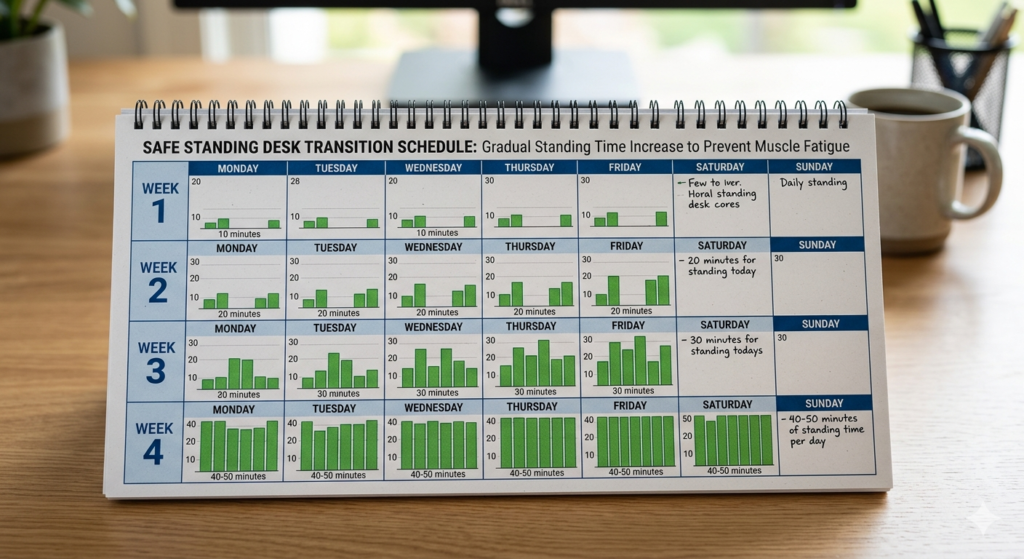
Week 1: The Micro-Intervals
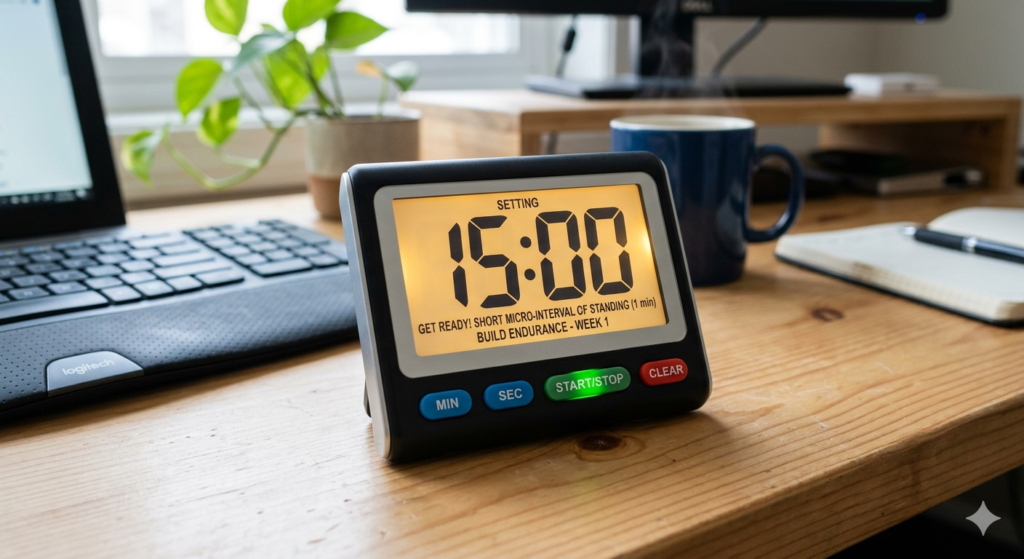
During your first week, aim to stand for only 10 to 15 minutes at a time, roughly two or three times a day. The total standing time for the entire workday should not exceed 45 minutes.
- Focus: Perfect posture. Keep your knees soft and your weight evenly distributed.
- Rule: The moment you feel the urge to shift your weight unevenly or lean on your desk, sit down.
Week 2: Establishing a Rhythm
In week two, slightly increase the duration of each standing block to 20 minutes, performing this three to four times a day.
- Total Goal: 60 to 80 minutes of accumulated standing time per day.
- Observation: You will likely experience some mild muscle soreness in your legs. This is the normal process of breaking in your body.
Weeks 3 & 4: Endurance Building
By week three, the initial shock to your system will have passed. Your joints are more resilient, and your stabilizing muscles are ready for longer intervals of continuous load.
Week 3: The Half-Hour Blocks
Increase your standing intervals to 30 minutes, performed three to four times a day. You are now crossing the threshold into active endurance building.
- Total Goal: 90 to 120 minutes of accumulated standing time.
- Action: Incorporate dynamic movement. Shift your weight slightly, perform a few calf raises, or rock on your heels to keep blood circulating.
Week 4: Finding Your Optimal Ratio
In the final week of the transition, extend your standing blocks to 40 or 45 minutes. You are now equipped to follow advanced sit-stand schedules without pain. As detailed in our foundational guide, The Complete Guide to Standing Desk Benefits and Transitioning, the ultimate goal is not to stand all day, but to seamlessly alternate between postures to maintain metabolic health.
Managing Calf Tightness and Fatigue
Throughout this 4-week process, the most common physical complaint is calf tightness. The gastrocnemius and soleus muscles in your lower legs act as primary stabilizers when you stand, and they absorb the majority of the gravitational stress.
To manage this tightness, you must proactively stretch your calves every time you lower your desk to sit. Furthermore, venous pooling (blood settling in the lower legs) contributes heavily to a feeling of tired, heavy legs. To support circulation during these longer blocks and prevent that aching feeling, wearing compression socks can gently squeeze the vein walls, encouraging blood to return to the heart and significantly reducing muscle vibration and fatigue.
Conclusion
A successful standing desk transition requires patience and a strategic approach to physical conditioning. By utilizing progressive loading across a 4-week schedule, you allow your bones, joints, and muscles to safely adapt to the demands of upright work. Focus on short intervals during the breaking-in phase, prioritize endurance building in the later weeks, and actively manage calf tightness to ensure your new workstation remains a tool for vitality rather than a source of pain.
Frequently Asked Questions (FAQ)
How long does it take to get used to a standing desk?
For most people, it takes approximately 3 to 4 weeks of consistent, gradual use for the body to adapt to a standing desk without experiencing significant joint pain or muscular fatigue.
Why are my legs so tired after using a standing desk?
Your legs are tired because standing requires continuous, low-level muscle contractions from your calves, thighs, and glutes to keep you upright. If you are not conditioned for this, the muscles quickly deplete their oxygen stores, leading to fatigue and soreness.
Is it normal for my lower back to hurt when adjusting to a standing desk?
Mild muscle soreness in the lower back is normal as those stabilizing muscles grow stronger. However, sharp or burning pain is not normal; it usually indicates that you are standing for too long or locking your knees, which forces your pelvis out of alignment.
Should I use a footrest while standing?
Yes, using a small footrest (or a stable block) while standing is highly recommended. Placing one foot on a raised surface allows you to shift your weight slightly, encourages a slight bend in the knee, and reduces tension on the lower back.